

NEWS
When machines face both radial and axial forces, choosing the right bearing can directly affect performance, service life, and maintenance costs. In the debate of Spherical Roller Bearing vs Tapered Roller Bearing, understanding how each type manages combined loads is essential for engineers, buyers, and maintenance teams. This article explores their load-handling strengths, typical applications, and key selection factors to help you make a more confident decision.
How Do Spherical Roller Bearing and Tapered Roller Bearing Handle Combined Loads?
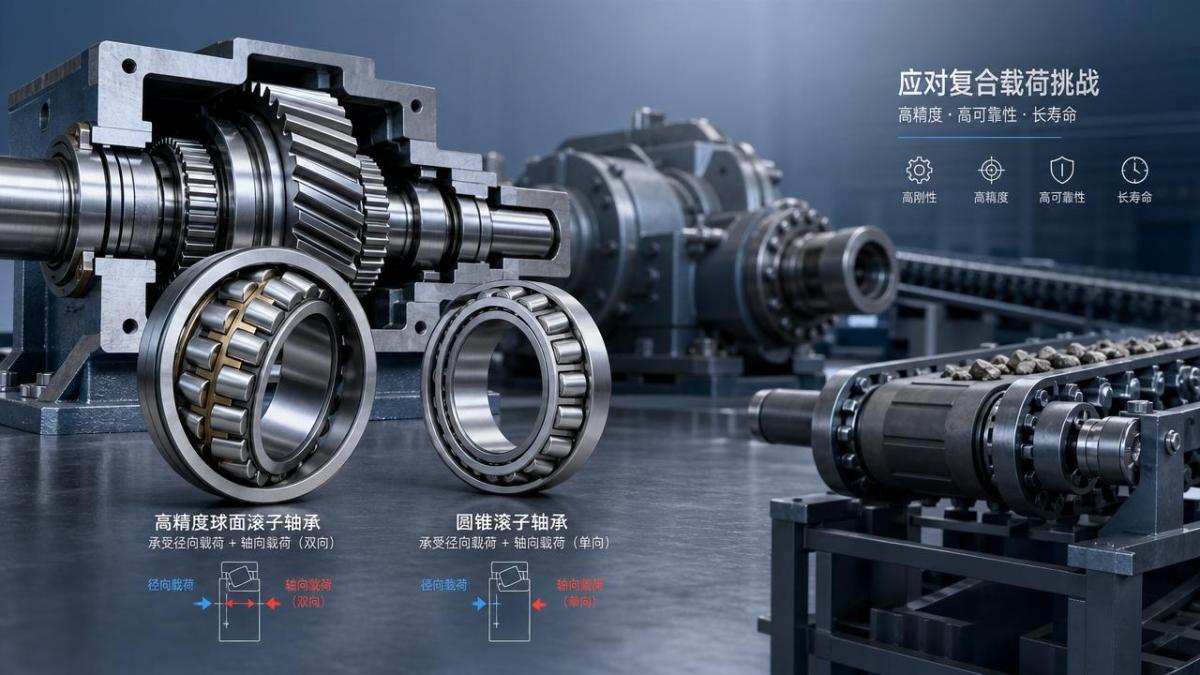
Combined loads are common in gearboxes, rolling mills, conveyors, crushers, pumps, fans, and heavy vehicle axles. In these conditions, the bearing must support radial force and axial force at the same time while still maintaining alignment, lubrication stability, and acceptable running temperature.
The comparison of Spherical Roller Bearing vs Tapered Roller Bearing usually starts with internal geometry. A spherical roller bearing uses barrel-shaped rollers and a spherical raceway, allowing self-alignment. A tapered roller bearing uses conical rollers and raceways, creating a line of contact that is highly effective for combined loads, especially where axial control matters.
Both types can carry combined loads, but they do not solve the same engineering problem. One is often selected for misalignment tolerance and heavy radial duty. The other is often preferred when axial positioning, rigidity, and predictable preload are critical.
- Spherical roller bearings are strong in high radial loads, shaft deflection, and housing misalignment.
- Tapered roller bearings are strong in combined radial and axial loads where shaft guidance is more precise.
- The better option depends on load direction, mounting arrangement, speed, lubrication, and operating environment.
Key Differences in the Spherical Roller Bearing vs Tapered Roller Bearing Decision
Before selecting a bearing for combined loads, buyers and engineers should compare the two types across load path, alignment behavior, stiffness, installation complexity, and typical failure risks. The table below summarizes the most important practical differences.
This comparison shows why there is no universal winner in Spherical Roller Bearing vs Tapered Roller Bearing. The real question is whether your machine needs self-alignment and heavy radial endurance, or more accurate axial control and structural stiffness.
Which Bearing Type Fits Different Industrial Applications?
Application context often reveals the answer faster than a pure catalog comparison. The same combined load can behave very differently depending on vibration level, impact loading, shaft movement, housing accuracy, sealing design, and maintenance conditions.
Where spherical roller bearings are often the better choice
A spherical roller bearing is commonly favored in harsh industrial environments where load is heavy, alignment is not perfect, and reliability under contamination matters more than exact shaft location. It is often used in conveyors, crushers, screeners, bulk handling systems, and large industrial fans.
- Shafts that deflect under load or operate in long-span arrangements.
- Housings with moderate mounting deviation or structural movement.
- Applications exposed to dust, moisture, shock loading, or frequent startup cycles.
Where tapered roller bearings are often the better choice
A tapered roller bearing is commonly chosen when the shaft must be guided precisely under combined loads. It is widely used in wheel ends, transmissions, pinion supports, differential systems, industrial gearboxes, and machine assemblies where preload or end-play adjustment influences performance.
- Rotating systems with meaningful thrust load in one or both directions.
- Installations where stiffness improves gear meshing or shaft accuracy.
- Assemblies where matched pairs or adjusted preload are part of the design.
Application Scenario Table for Spherical Roller Bearing vs Tapered Roller Bearing
For buyers comparing Spherical Roller Bearing vs Tapered Roller Bearing across real operating scenarios, the following table can shorten the evaluation process and reduce selection mistakes during procurement.
This scenario-based view helps non-design teams as well. Purchasing managers can use it to screen quotations, and maintenance teams can use it to judge whether repeated failures come from wrong bearing type rather than only lubrication or seal problems.
What Technical Factors Matter Most in Combined Load Selection?
Load ratio and direction
Start with the ratio between radial and axial force. If radial load dominates and axial force is moderate while alignment cannot be guaranteed, a spherical roller bearing may be more practical. If axial load is substantial or shaft positioning is part of system accuracy, a tapered roller bearing often becomes the stronger candidate.
Speed and heat generation
Speed changes the decision. At higher speed, lubrication film stability, friction, and heat dissipation become more important. Tapered roller bearings can perform very well, but mounting accuracy and preload control must be right. Spherical roller bearings also need proper internal clearance and lubricant selection to avoid excess heat under load.
Alignment and shaft deflection
This is one of the biggest decision points in Spherical Roller Bearing vs Tapered Roller Bearing. If the shaft bends under process load, or if the housing seat is hard to machine accurately, self-aligning capability can protect service life. Tapered roller bearings are less forgiving and may show edge stress or abnormal wear if the mounting geometry is poor.
Lubrication method and contamination level
Oil bath, grease, circulating oil, and sealed arrangements all influence the final choice. Dirty environments often shift the decision toward more robust layouts with stronger tolerance to adverse conditions. In clean, controlled assemblies, tapered roller bearings can deliver very stable performance and predictable adjustment.
How Should Buyers Compare Cost, Maintenance, and Replacement Risk?
Initial unit price matters, but it should never be the only filter. In bearing procurement, the total cost of ownership includes installation time, lubrication demand, alignment sensitivity, downtime risk, and the cost of replacing damaged shafts, seals, or housings after a bearing failure.
Common cost drivers
- Mounting complexity: tapered roller bearings may require more precise adjustment, especially in paired sets.
- Housing and shaft accuracy: poor fits create early failure risk and hidden maintenance cost.
- Lubrication intervals: harsh-duty applications may need frequent inspection regardless of bearing type.
- Downtime sensitivity: in critical equipment, the wrong choice can cost far more than the bearing itself.
If the machine runs in a difficult environment with limited maintenance access, a spherical roller bearing may reduce operational risk even if another type looks competitive on paper. If the machine requires repeatable shaft positioning and controlled running geometry, a tapered roller bearing may reduce long-term adjustment problems.
Procurement Checklist: What to Confirm Before Ordering?
The Spherical Roller Bearing vs Tapered Roller Bearing question often reaches the purchasing team before all technical details are fully defined. A structured checklist can prevent specification gaps and shorten quotation cycles.
A capable supplier should be able to discuss not only dimensions, but also fit tolerance, internal clearance, cage style, lubrication route, and installation concerns. That level of support is often what separates a workable choice from a costly field correction.
Common Mistakes in the Spherical Roller Bearing vs Tapered Roller Bearing Debate
Many failures come from decision shortcuts rather than material defects. Teams often choose by habit, old drawings, or price only, without reviewing the actual combined load path and machine behavior.
- Assuming all combined-load applications automatically need tapered roller bearings.
- Ignoring shaft deflection and housing misalignment in heavy process equipment.
- Treating dynamic load rating as the only selection criterion.
- Overlooking preload, end play, and fit accuracy during tapered roller bearing installation.
- Underestimating contamination, sealing limits, and lubrication quality in real service.
A more reliable approach is to evaluate the bearing as part of the whole assembly. Load, speed, fit, lubrication, sealing, and maintenance practice should be reviewed together rather than in isolation.
FAQ About Spherical Roller Bearing vs Tapered Roller Bearing
Which bearing is better for high radial load with some axial load?
If radial load is dominant and the machine may experience shaft deflection or mounting inaccuracy, a spherical roller bearing is often the safer choice. If axial load is also significant and shaft guidance must remain tight, a tapered roller bearing may perform better.
Can a tapered roller bearing replace a spherical roller bearing directly?
Not always. Even if dimensions seem manageable, the two designs behave differently in alignment tolerance, stiffness, and axial load path. A direct replacement without checking fit, preload, housing geometry, and lubrication can create new failure modes.
Which type is easier to maintain in dirty industrial environments?
In many heavy-duty and contaminated settings, spherical roller bearings are considered more forgiving because they tolerate misalignment better and are commonly used in robust housed arrangements. However, sealing design and relubrication practice still remain critical.
What should buyers ask when comparing supplier quotations?
Ask about load assumptions, recommended fits, internal clearance or preload approach, cage material, lubrication suggestion, sealing advice, lead time, sample support, and interchangeability. For combined loads, these details are often more important than unit price alone.
Why Contact Us for Bearing Selection Support?
If you are still comparing Spherical Roller Bearing vs Tapered Roller Bearing, practical engineering support can save time and reduce risk before purchase. Selection errors usually happen when load direction, alignment condition, speed, and maintenance limits are not reviewed together.
You can contact us to discuss specific bearing parameters, application conditions, replacement compatibility, delivery timing, sample support, and quotation planning. We can also help review whether your application needs self-aligning performance, axial positioning control, a paired arrangement, or a more suitable lubrication and sealing approach.
For procurement teams, this means faster model confirmation and clearer comparison of technical options. For maintenance teams, it means fewer repeat failures caused by mismatched bearing type. For equipment builders, it means a more confident path from design intent to reliable field operation.
Awesome! Share to:


Get in Touch
*We respect your confidentiality and all information are protected.