

NEWS
Cylindrical Roller Bearing vs Ball Bearing: What Really Changes in Selection
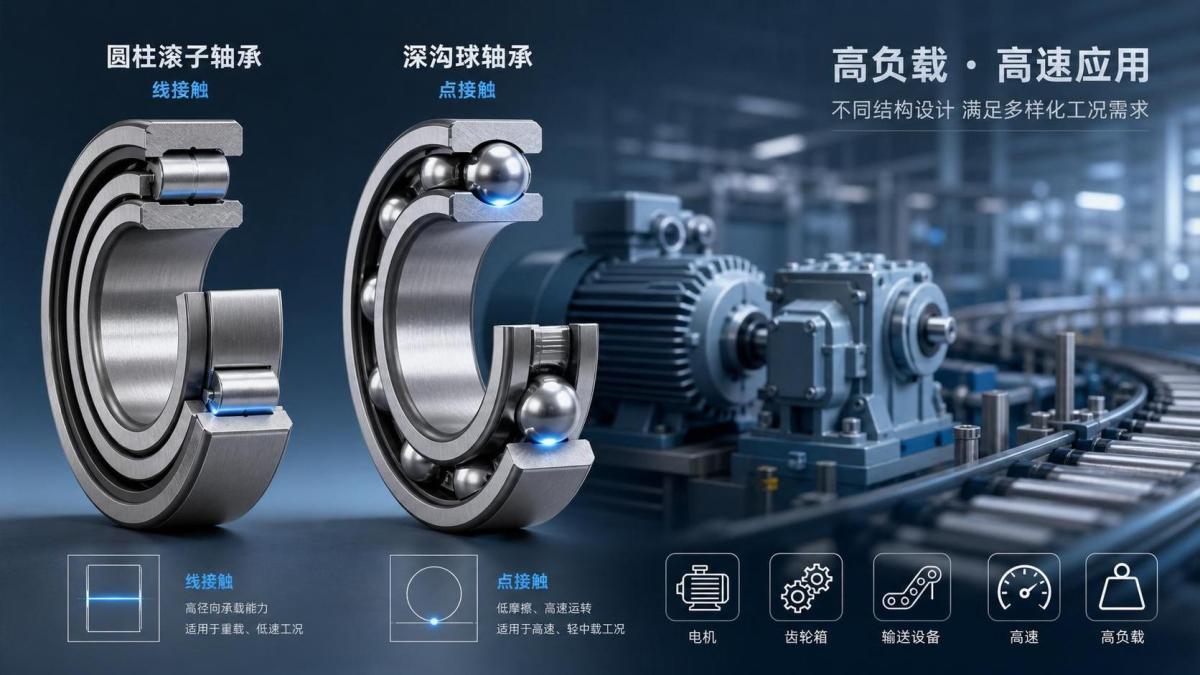
When evaluating bearing options for industrial equipment, understanding the performance gap between a Cylindrical Roller Bearing and a ball bearing is essential.
Each design brings a different balance of load support, speed, friction, stability, and service life.
That difference matters in motors, gearboxes, conveyors, pumps, compressors, and precision production lines.
A wrong choice can raise downtime, lubrication demand, replacement frequency, and total operating cost.
A better choice improves reliability without overspending on unnecessary performance.
This guide compares Cylindrical Roller Bearing performance against ball bearing behavior in practical buying situations.
The goal is simple: make load, speed, and cost trade-offs easier to judge before purchase.
Basic Design Difference
A ball bearing uses rolling balls as contact elements.
A Cylindrical Roller Bearing uses rollers with line contact rather than point contact.
That single design difference changes load distribution, stiffness, heat generation, and speed response.
In practical terms, line contact spreads force over a larger area.
This is why a Cylindrical Roller Bearing usually carries heavier radial loads than a similarly sized ball bearing.
Ball bearings, however, often maintain lower friction and better high-speed behavior.
Load Capacity: Where Cylindrical Roller Bearing Leads
If radial load is the main concern, the Cylindrical Roller Bearing usually has the advantage.
Its roller geometry supports heavier loads without needing a larger outer size.
That makes it attractive for heavy machinery, mining systems, rolling mills, and industrial transmissions.
A ball bearing works well under moderate radial load and light combined load.
But under repeated shock or sustained heavy force, its contact area becomes a limitation.
This does not mean every heavy-duty system must use a Cylindrical Roller Bearing.
It means radial load should be matched to real operating conditions, not nameplate assumptions.
- Choose a Cylindrical Roller Bearing when radial load is high and continuous.
- Choose a ball bearing when load is lighter and speed is more critical.
- Review peak load events, not only average operating load.
Speed Capability: Where Ball Bearing Often Wins
When shaft speed rises, the comparison becomes more nuanced.
Ball bearings generally run faster because they create less internal friction.
They also tend to generate less heat in high-RPM applications.
A Cylindrical Roller Bearing can still operate at strong speed levels.
However, its practical speed limit depends more heavily on cage design, lubrication quality, and alignment control.
In fans, electric motors, machine tool spindles, and compact drives, ball bearings often make more sense.
In lower-speed, high-load applications, Cylindrical Roller Bearing performance becomes more compelling.
So the question is not which type is faster in theory.
The better question is whether your operating speed stays stable under real thermal and load conditions.
Axial Load, Rigidity, and Alignment Considerations
Load direction matters just as much as load size.
A standard Cylindrical Roller Bearing is designed mainly for radial load.
Many versions offer limited axial support, depending on rib design and internal configuration.
Ball bearings often handle combined radial and axial loads more easily.
That flexibility simplifies selection for applications with changing load directions.
On the other hand, a Cylindrical Roller Bearing provides greater radial rigidity.
Higher rigidity supports better shaft stability under heavy force.
This can improve consistency in equipment where deflection affects output quality.
Alignment also deserves attention because roller bearings can be less forgiving of installation errors.
If mounting precision is weak, the expected advantage of a Cylindrical Roller Bearing may fade quickly.
Friction, Heat, and Lubrication Costs
Selection decisions often look good on paper and fail in operating cost reviews.
That usually happens when friction, heat, and lubrication are underestimated.
A ball bearing normally has lower friction torque.
That helps reduce power loss and keeps thermal behavior easier to manage.
A Cylindrical Roller Bearing may require more careful lubrication planning, especially at higher speeds.
Oil quality, grease interval, contamination control, and sealing all matter more here.
In harsh environments, these extra requirements may still be worthwhile.
The reason is simple: the load-carrying benefit may outweigh the added maintenance effort.
For buyers comparing total cost, lubrication strategy should be part of the first conversation, not the last.
Application Fit: Where Each Bearing Makes Better Sense
A good selection process starts with application fit, not product familiarity.
Use a Cylindrical Roller Bearing when the machine faces high radial loads, strong shock, or stiffness demands.
Common examples include gearboxes, rolling equipment, large pumps, compressors, and industrial reducers.
Use a ball bearing when speed, lower friction, quiet running, and simpler combined-load support matter more.
That is common in electric motors, fans, light conveyors, small pumps, and general machinery.
In some sourcing situations, teams also compare related bearing solutions.
For example, specialized load-direction needs may lead buyers to review China Manufacturer Famous Brand Factory Bearing Tapered Roller Bearing 2303115 Quality Product Fast Delivery Any Size alongside standard options.
This does not replace the Cylindrical Roller Bearing comparison.
It simply reflects how real purchasing decisions often include several bearing families before final approval.
Practical Decision Table
This side-by-side view helps shorten early evaluation cycles.
Still, final selection should always reflect your actual duty cycle and maintenance resources.
How to Choose with Less Risk
If the decision is close, use a simple screening process.
- Confirm real radial and axial loads, including peaks.
- Check shaft speed under full operating temperature.
- Review alignment control and installation quality.
- Estimate lubrication cost across the service cycle.
- Compare downtime risk, not only purchase price.
This process makes the Cylindrical Roller Bearing decision more objective.
It also helps avoid buying a ball bearing simply because it is familiar or easy to source.
In many operations, the better result comes from matching the bearing to the risk profile, not the catalog headline.
Final Takeaway
The core difference is straightforward.
A Cylindrical Roller Bearing is usually the stronger option for heavy radial load and higher rigidity.
A ball bearing is often the easier choice for higher speed, lower friction, and mixed operating conditions.
The best choice depends on what failure would cost more in your operation: overload, heat, misalignment, or downtime.
Start with load direction, speed range, lubrication reality, and service expectations.
From there, the right bearing choice becomes much clearer and far easier to defend internally.
Awesome! Share to:


Get in Touch
*We respect your confidentiality and all information are protected.