

NEWS
How to select Deep Groove Ball Bearings for low noise? The answer starts with understanding how design precision, material quality, lubrication, and internal clearance affect vibration and sound levels in real applications. Choosing the right bearing is not only about smooth rotation, but also about improving equipment comfort, reliability, and service life. In this guide, we will explore the key factors that help you make a quieter, more efficient bearing selection.
Why do deep groove ball bearings create noise in the first place?
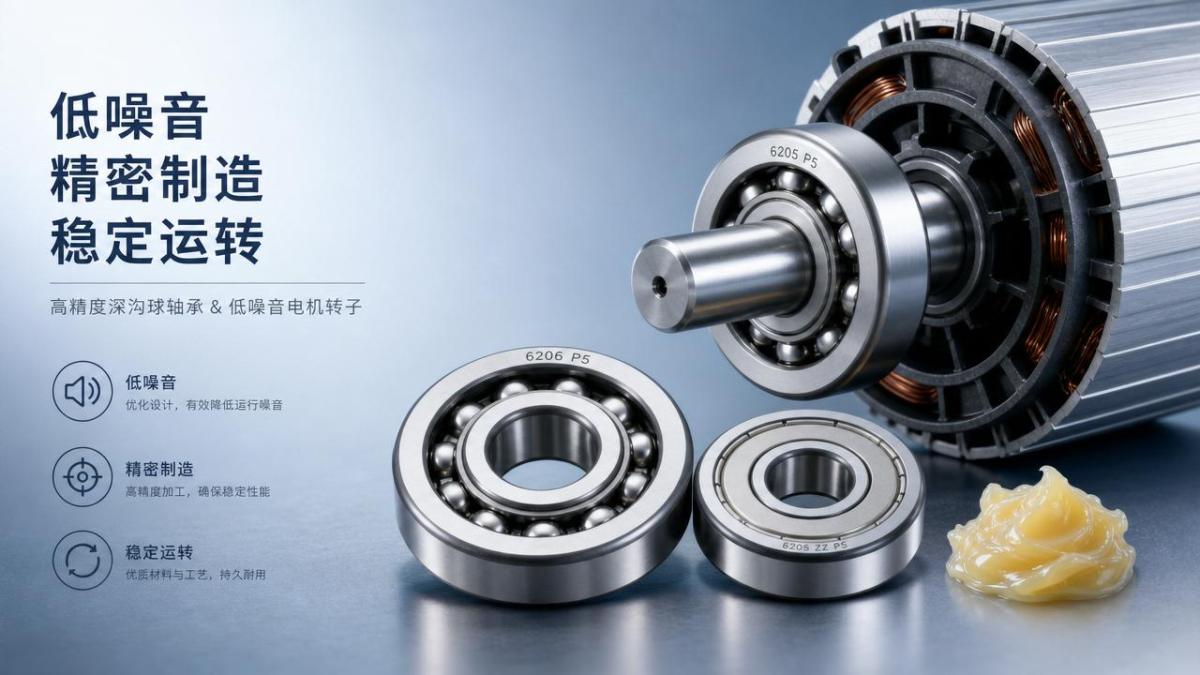
When buyers ask how to select Deep Groove Ball Bearings for low noise, they often focus only on speed rating or price. In practice, noise comes from a combination of vibration sources inside the bearing system.
A deep groove ball bearing may sound louder because of raceway waviness, uneven ball size, cage instability, lubricant starvation, contamination, poor shaft fit, or excessive preload. Even a good bearing can become noisy in a poor assembly environment.
This matters in motors, fans, medical devices, office equipment, home appliances, and precision pumps. In these applications, users do not only judge machine quality by output. They also notice sound, smoothness, and comfort.
- Geometric errors such as raceway roundness deviation can create periodic vibration during rotation.
- Low-grade steel or poor heat treatment may reduce surface stability and raise running noise over time.
- Improper grease type or grease quantity can increase friction torque and generate abnormal acoustic behavior.
- Internal clearance that is too large or too small can shift contact conditions and worsen vibration levels.
- Dust, burrs, and installation impact marks often cause noise that is wrongly blamed on the bearing itself.
So, how to select Deep Groove Ball Bearings for low noise? Start by treating the bearing as part of a full operating system, not as an isolated catalog item.
Which bearing factors have the biggest effect on low-noise performance?
For low-noise applications, several technical details deserve closer attention. Buyers who compare only dimensions and load ratings usually miss the factors that most strongly influence acoustic performance.
1. Manufacturing precision
Higher precision reduces runout, vibration, and local contact irregularity. Tighter control of raceway geometry and ball grade helps maintain stable rolling motion, especially at high speed or under light load.
2. Surface finish and cleanliness
Fine surface roughness and strict cleanliness standards help minimize micro-impacts. In low-noise electric motors, small particles trapped in grease can quickly become a major source of sound.
3. Cage design
Pressed steel cages, machined cages, and polymer cages behave differently. The right cage depends on speed, temperature, lubrication condition, and expected noise sensitivity. A stable cage reduces ball slip and contact variation.
4. Internal clearance
Clearance directly affects contact angle, friction, and vibration. In many quiet-running applications, normal clearance or carefully controlled reduced clearance performs better than a larger loose fit, but the correct choice depends on temperature and fit conditions.
5. Lubrication quality
Grease for low-noise bearings should offer good film stability, low separation tendency, and clean composition. The grease filling level also matters. Too much grease may increase churning noise, while too little can lead to metal contact.
The table below summarizes the most important technical factors when evaluating how to select Deep Groove Ball Bearings for low noise in practical purchasing work.
This comparison shows that low-noise bearing selection is not a one-factor decision. A quieter result usually comes from balancing precision, lubrication, clearance, and assembly conditions together.
How to choose the right bearing for different low-noise applications?
Application context changes the answer to how to select Deep Groove Ball Bearings for low noise. The same bearing that performs well in a desk fan may not be suitable for a medical pump or servo motor.
Home appliances and comfort-focused products
For air purifiers, washing machines, and small fans, buyers usually prioritize smooth sound, stable supply, and reasonable cost. Sealed bearings with clean low-noise grease are often preferred because they help reduce contamination risk.
Electric motors and office equipment
Motors demand consistent rotational accuracy. Here, shaft and housing tolerances matter almost as much as the bearing itself. A quiet motor bearing should have controlled vibration level, suitable radial clearance, and grease compatible with startup frequency.
Medical, laboratory, and precision equipment
In sensitive equipment, low noise often goes together with low vibration and long service stability. Buyers typically need stricter cleanliness, stable batch quality, and clear technical communication during selection.
The following application table helps compare typical low-noise selection priorities across common industries in the bearing market.
A clear application-based approach helps buyers avoid over-specifying expensive bearings or under-specifying parts that later create customer complaints and warranty costs.
What should procurement teams check before placing an order?
Many noise issues begin long before installation. They start during sourcing, when the purchasing team does not ask the right technical questions. If you want a dependable answer to how to select Deep Groove Ball Bearings for low noise, procurement must work closely with engineering.
- Confirm operating speed range, radial load, axial load, and duty cycle rather than using a generic bearing request.
- Define the acceptable noise or vibration expectation for the final product, especially if it is consumer-facing or precision-oriented.
- Check whether open, shielded, or sealed deep groove ball bearings are more suitable for contamination control and lubricant retention.
- Ask about grease brand type, grease amount, and whether the supplier can recommend a low-noise lubrication option.
- Review fit tolerances for shaft and housing because interference can change internal clearance after mounting.
- Request consistency information for batch supply if the product will enter volume production.
This checklist is especially useful when delivery schedules are tight. It helps reduce the risk of receiving bearings that meet catalog dimensions but fail acoustic expectations in final assembly.
How do low-noise options compare on cost, risk, and value?
Low-noise deep groove ball bearings are not always the cheapest option at purchase stage. However, the total cost picture often changes when you include rework, customer complaints, machine resonance troubleshooting, and early replacement.
A lower-priced bearing may work in a basic machine with little acoustic sensitivity. But if the equipment operates close to users, even small noise variation can affect product acceptance. That makes stable quality more valuable than the lowest unit cost.
- Standard commercial bearings may fit cost-driven projects but often need tighter process control in assembly to remain quiet.
- Higher precision low-noise bearings usually cost more, yet they can reduce vibration debugging time and field-return risk.
- Sealed bearings may cost slightly more than open bearings but often improve cleanliness and lubricant retention in compact equipment.
In other words, the best bearing choice depends on total operating value, not just invoice price. That is a key principle behind how to select Deep Groove Ball Bearings for low noise wisely.
Which standards and technical references are worth checking?
For professional bearing selection, it is helpful to refer to common industry standards and technical practices. These references do not replace application testing, but they improve communication between buyer, engineer, and supplier.
- ISO dimensional and tolerance standards help verify interchangeability and basic bearing accuracy.
- ABEC or equivalent precision classifications may be referenced in some markets, especially for higher-speed applications.
- Vibration and noise inspection methods vary by supplier, so buyers should ask how consistency is checked during production and outgoing inspection.
- Lubrication recommendations should be matched to operating temperature, speed factor, and expected service interval.
A capable supplier should be able to explain these points clearly, translate them into practical selection advice, and help buyers avoid choosing a specification that looks correct on paper but performs poorly in use.
Common mistakes when selecting deep groove ball bearings for low noise
Some low-noise projects fail not because the bearing category was wrong, but because the selection logic was incomplete. These mistakes appear often in both OEM purchasing and replacement buying.
Choosing by size only
A bearing that matches bore, outer diameter, and width may still be unsuitable if its clearance, grease, sealing type, or vibration control level does not fit the machine.
Ignoring installation conditions
Pressing force through rolling elements, tilted mounting, and dirty assembly areas can create immediate noise. This can lead users to replace good bearings unnecessarily.
Using the same bearing across very different duty cycles
A low-speed household product and a high-speed motor may share the same nominal size, but their noise behavior and lubrication demands are very different.
Treating grease as a secondary detail
For quiet running, grease is a core design input. The wrong grease can increase sound even if the bearing geometry is excellent.
FAQ: practical answers for buyers and engineers
How to select Deep Groove Ball Bearings for low noise in electric motors?
Focus on vibration-controlled production quality, correct internal clearance after fit, suitable grease for motor speed, and shaft-housing tolerance matching. Also review rotor balance and mounting method because motor noise is often system-related.
Are sealed bearings better for low-noise applications?
In many cases, yes. Sealed deep groove ball bearings help keep grease clean and reduce external contamination. They are often a practical choice for appliances, office equipment, and compact motors, although speed and temperature limits must still be checked.
Does a higher precision grade always mean lower noise?
Not always. Higher precision can support lower vibration, but poor lubrication, incorrect clearance, or bad installation can still cause noise. Precision helps, yet it must be combined with correct application matching.
What is the most overlooked point in low-noise bearing selection?
The most overlooked point is post-mount operating clearance. Many teams choose a bearing by catalog value but forget that tight fits and thermal growth can reduce clearance and raise running noise.
Why choose us for low-noise bearing selection support?
If you are comparing suppliers and still deciding how to select Deep Groove Ball Bearings for low noise, practical engineering support can save time and reduce sourcing risk. What matters is not generic promises, but the ability to discuss your real operating conditions clearly.
We can support parameter confirmation for speed, load, fit, sealing type, and lubrication preference. We can also help review whether your application needs a standard bearing, a quieter grease option, or a more controlled vibration-grade solution.
If your project is time-sensitive, you can contact us to discuss sample support, product selection, lead time expectations, replacement equivalence, and quotation details. If your application has special acoustic requirements, we can communicate around use conditions before order confirmation to reduce trial-and-error costs.
For OEM, maintenance, or export purchasing teams, a clear technical discussion at the beginning often leads to a quieter product, smoother procurement, and more reliable long-term performance.
Awesome! Share to:


Get in Touch
*We respect your confidentiality and all information are protected.