

NEWS
Choosing the wrong bearing type can quietly reduce efficiency, increase wear, and shorten equipment service life. In many industrial applications, the decision between Spherical Roller Bearing vs Tapered Roller Bearing directly affects load handling, alignment tolerance, and long-term reliability. Understanding how each design performs under different operating conditions is essential for preventing premature failure and improving overall machine performance.
Why does the choice between Spherical Roller Bearing vs Tapered Roller Bearing matter so much?
Many failures that look like lubrication problems or material defects actually start with incorrect bearing selection. A bearing may fit the shaft and housing, yet still be wrong for the real load direction, shaft deflection, shock level, or alignment condition.
When engineers compare Spherical Roller Bearing vs Tapered Roller Bearing, they are not only comparing shapes. They are choosing between different internal geometries, contact behaviors, speed capabilities, mounting methods, and tolerance to installation or operating variation.
A mismatch can lead to heat generation, uneven load zones, edge stress, cage damage, raceway spalling, and seal degradation. In heavy-duty bearing applications, the service life penalty can be substantial even when the machine seems to run normally at first.
- If the application has frequent misalignment, a rigid bearing arrangement can overload the roller ends and raceway edges.
- If axial load is underestimated, the wrong roller bearing type may lose stability and wear rapidly.
- If preload or internal clearance is not matched to the design, friction and temperature may rise beyond acceptable limits.
Core design difference at a glance
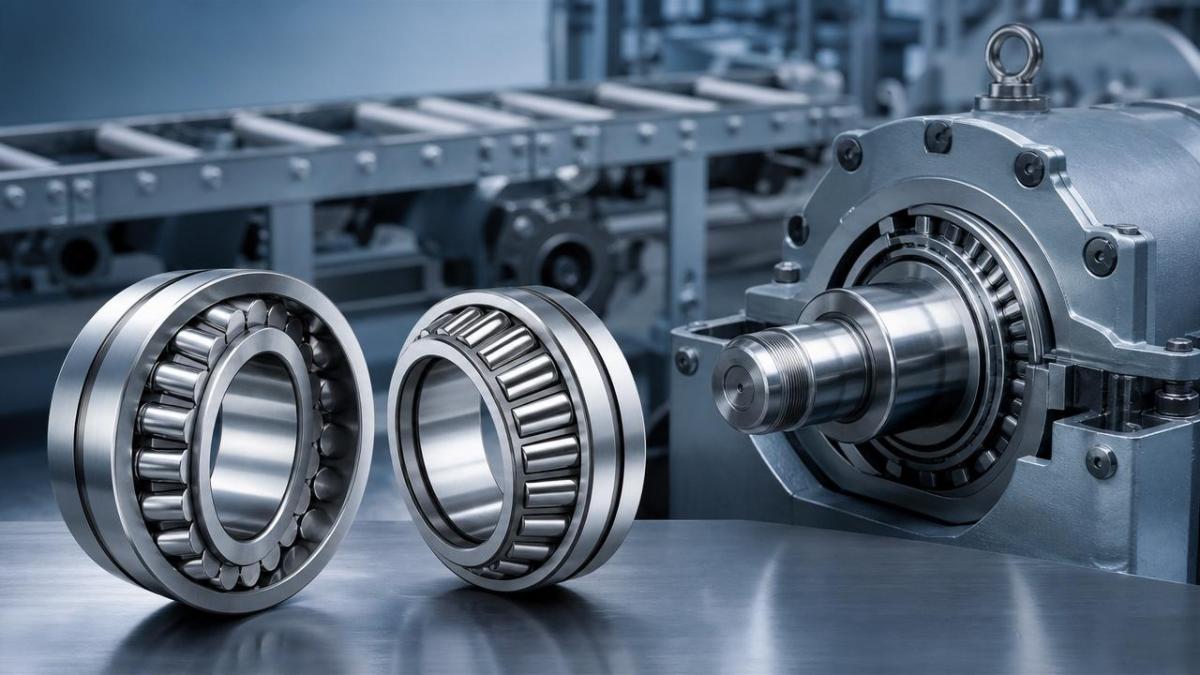
Spherical roller bearings use barrel-shaped rollers and a self-aligning internal design. They are built to carry high radial loads and moderate axial loads while accommodating shaft and housing misalignment. Tapered roller bearings use conical rollers and raceways, making them especially effective for combined radial and axial loads with accurate load control.
How do their load behaviors differ in real operating conditions?
Load direction is often the first decision point in Spherical Roller Bearing vs Tapered Roller Bearing selection. However, real machinery rarely sees a single clean load. Most systems combine radial force, thrust force, shock, vibration, and occasional overload.
The table below helps clarify how each bearing type behaves under typical industrial loading and installation conditions. It is useful for maintenance teams, purchasing engineers, and equipment designers evaluating bearing service life risk.
This comparison shows why the wrong choice can shorten service life. If the machine needs axial stiffness and controlled thrust support, using a spherical design may compromise positioning. If the machine suffers deflection or mounting inaccuracy, using a tapered design may create concentrated stress and early damage.
When radial load is dominant
Spherical roller bearings are commonly preferred in conveyors, crushers, vibrating screens, fans, and gearboxes where radial load is high and misalignment is difficult to avoid. Their self-aligning structure helps distribute load more safely when shafts bend under heavy duty conditions.
When axial load and positioning accuracy matter
Tapered roller bearings are widely used in wheel hubs, transmissions, pinion shafts, rolling mills, and machine assemblies where axial load must be managed more deliberately. In these cases, proper arrangement and adjustment are critical to achieving stable service life.
Which bearing type fits specific application scenarios better?
Application context is more important than catalog ratings alone. The same load number can behave very differently depending on contamination, mounting tolerance, shock frequency, lubrication method, and duty cycle. That is why Spherical Roller Bearing vs Tapered Roller Bearing should always be evaluated in relation to the actual machine.
The following scenario table supports faster selection by linking operating conditions to the more suitable roller bearing design.
The table confirms that there is no universal winner in Spherical Roller Bearing vs Tapered Roller Bearing selection. Service life depends on matching the internal design to the mechanical reality, not on choosing the bearing that simply appears more robust.
Common industries where the wrong choice causes hidden losses
- Mining and aggregates, where misalignment and contamination often destroy improperly selected tapered bearings.
- Automotive and trailer systems, where spherical bearings may not deliver the axial control required for wheel-end performance.
- Industrial gearboxes, where wrong internal clearance or thrust assumptions can reduce bearing life and damage adjacent components.
What technical factors should buyers check before making a decision?
Procurement teams often receive only basic dimensions and a part number reference. That is rarely enough. A reliable Spherical Roller Bearing vs Tapered Roller Bearing decision should be based on operating data, not assumptions or price alone.
Critical selection checklist
- Define the real load mix. Estimate radial load, axial load, shock load, and whether the thrust direction changes during operation.
- Check alignment conditions. Measure shaft deflection, housing tolerance, and installation repeatability across maintenance cycles.
- Review speed and temperature. Higher speed and thermal growth can affect internal clearance, lubricant film, and bearing stability.
- Assess lubrication and contamination. Dirty environments may favor designs and sealing arrangements that better survive harsh conditions.
- Confirm mounting method. Tapered roller bearings usually need careful preload or endplay setting, while spherical roller bearings require correct fits and clearance control.
Standards and technical references worth considering
General industry practice often refers to ISO bearing dimensions, tolerance classes, and internal clearance standards, along with application-specific installation procedures. For replacement projects, buyers should also compare shaft seat condition, housing geometry, and lubrication compatibility rather than relying only on interchange dimensions.
Can a lower purchase price actually increase total bearing cost?
Yes. A lower initial unit price can lead to a much higher operating cost if the bearing type is wrong for the application. In Spherical Roller Bearing vs Tapered Roller Bearing evaluation, the real question is total cost of ownership, not invoice price alone.
Below is a practical cost-focused comparison that purchasing and maintenance teams can use when reviewing replacement strategies or reducing unplanned downtime.
For many plants, the best bearing decision is the one that reduces downtime, simplifies maintenance, and matches the machine duty cycle. Even if one type costs more upfront, it may be the more economical choice over the operating life of the equipment.
What mistakes do buyers and maintenance teams make most often?
Mistake 1: Selecting by dimensions only
Two bearing types may fit a similar space envelope but perform very differently. Dimensions never replace load path analysis, alignment review, and mounting requirements.
Mistake 2: Ignoring shaft and housing deflection
This is a major reason why tapered designs fail in heavy-duty equipment. If the machine structure moves under load, a spherical roller bearing may protect service life more effectively.
Mistake 3: Underestimating axial load
In some reducers, hubs, and driven assemblies, thrust load rises during transient operation, braking, or thermal expansion. A bearing chosen for radial load alone may fail earlier than expected.
Mistake 4: Poor installation control
Incorrect fit, preload, clearance, lubrication quantity, or seating force can ruin either bearing type. The more precise the design requirement, the more important installation discipline becomes.
FAQ about Spherical Roller Bearing vs Tapered Roller Bearing
Which lasts longer in heavy-duty machinery?
Neither lasts longer in every case. In misaligned, shock-loaded, contamination-prone equipment, spherical roller bearings often deliver better life. In systems with significant axial load and controlled setup, tapered roller bearings can provide stronger directional support and stable operation.
Is one type easier to install than the other?
Spherical roller bearings are often more forgiving when alignment is imperfect. Tapered roller bearings usually demand more attention to preload or endplay, especially in paired arrangements. Ease of installation should never outweigh functional suitability.
Can one type replace the other directly?
Direct substitution is risky unless the full application has been reviewed. Even if dimensions appear compatible, internal geometry, load direction, adjustment requirements, and alignment behavior may be completely different.
What information should be prepared before asking for a quotation?
Prepare bearing dimensions, shaft and housing fits, operating speed, radial and axial load estimates, lubrication method, working temperature, duty cycle, and any known failure history. This allows a more accurate Spherical Roller Bearing vs Tapered Roller Bearing recommendation.
Why choose us for bearing selection support?
In bearing procurement, the biggest risk is not always price. It is choosing a type that looks interchangeable but performs poorly in the field. We focus on helping buyers and technical teams reduce that risk with application-based selection support.
- We can assist with parameter confirmation, including load direction, speed, fit, clearance, and mounting conditions.
- We can discuss Spherical Roller Bearing vs Tapered Roller Bearing options based on your actual machine scenario rather than a generic catalog match.
- We can support quotation communication, sample planning, and lead time review for maintenance replacement or new project sourcing.
- We can help evaluate practical issues such as installation method, expected service interval, and whether a standard or adjusted solution is more suitable.
If you are comparing bearing types for a new design, replacing a failed unit, or trying to reduce downtime, contact us with your operating parameters. We can help review selection logic, confirm suitable bearing arrangements, discuss delivery timing, and support a more reliable purchasing decision.
Awesome! Share to:


Get in Touch
*We respect your confidentiality and all information are protected.