

NEWS
When quiet operation matters, many engineers ask whether sealed deep groove ball bearings offer a real advantage. If you are wondering How to select Deep Groove Ball Bearings for low noise?, the answer depends on more than sealing alone. Factors like lubrication, internal clearance, precision grade, and installation quality all influence sound levels. This article explores how sealed designs compare and what to evaluate for better noise control in demanding applications.
Are sealed deep groove ball bearings really better for noise control?
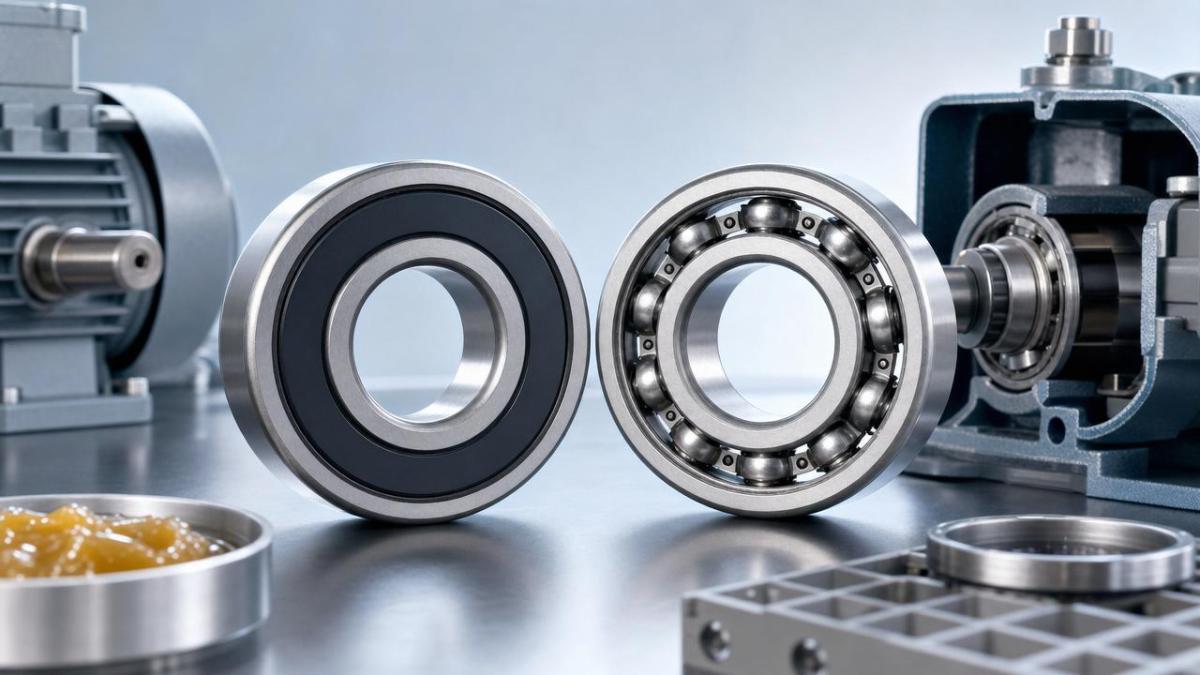
In many bearing applications, sealed deep groove ball bearings do help reduce noise, but not because the seal magically absorbs sound. The benefit usually comes from more stable grease retention, lower contamination risk, and better consistency during operation.
If you need to answer the question How to select Deep Groove Ball Bearings for low noise?, start with the full operating system. A sealed design can support quieter running, yet cage design, raceway finish, preload or clearance, shaft accuracy, and housing rigidity often matter just as much.
Open bearings may run quietly in clean, controlled environments with optimized lubrication. However, in real industrial settings, dust, moisture, and grease loss frequently increase vibration and sound over time. That is why sealed bearings are often preferred for long-term low-noise operation.
- Seals help keep grease inside the bearing, which supports a more stable lubricating film and reduces metal-to-metal contact noise.
- Seals block fine contaminants that can damage raceways and rolling elements, preventing noise growth during service life.
- Factory-filled sealed bearings reduce lubrication variation between units, which is useful when equipment requires predictable acoustic behavior.
How to select Deep Groove Ball Bearings for low noise in practical applications?
Low-noise selection is a combination of product design and application matching. Buyers often focus only on bearing type, but the better approach is to compare operating speed, radial and axial load, ambient cleanliness, mounting conditions, and expected service interval.
A deep groove ball bearing used in a household motor has a different noise target than one used in a conveyor, fan, medical device, or compact gearbox. In other words, low noise is not a single specification. It is an application-specific requirement.
Key factors that affect noise level
- Lubrication type and fill amount: Too little grease raises friction noise, while too much grease can cause churning and temperature rise.
- Seal contact design: Contact seals provide stronger protection but can increase friction torque. Non-contact seals reduce drag but may allow more contamination.
- Internal clearance: Incorrect clearance can lead to vibration, skidding, or excess preload after fitting.
- Precision and raceway quality: Better roundness, waviness control, and surface finish usually improve acoustic performance.
- Mounting accuracy: Misalignment, shaft runout, and housing out-of-round conditions can create noise even with a premium bearing.
For procurement teams, this means a low-noise bearing should never be selected from catalog dimensions alone. Ask for operating data, installation conditions, target speed, and maintenance expectations before confirming the bearing configuration.
Sealed vs open deep groove ball bearings: what changes acoustically?
The table below compares sealed and open deep groove ball bearings from a noise-control perspective. This is useful when evaluating How to select Deep Groove Ball Bearings for low noise? across different environments and maintenance strategies.
The main takeaway is clear: sealed bearings usually provide better real-world noise consistency, while open bearings may offer lower rotational drag in controlled systems. If your equipment faces dirt, variable maintenance, or long service intervals, sealed designs often make more sense.
Which technical parameters matter most when noise is the priority?
For engineers and buyers, the next step after choosing sealed or open construction is to review the technical parameters that strongly influence sound and vibration behavior. This is where many low-noise projects succeed or fail.
Critical selection points
- Choose the right grease for speed and temperature. Grease base oil viscosity, thickener type, and acoustic compatibility all matter.
- Match internal clearance to the fit and thermal expansion. A bearing that becomes too tight in operation often gets noisy.
- Consider precision level for high-speed or sound-sensitive equipment. Better dimensional consistency typically supports smoother running.
- Check cage material and design. Certain cage types behave better in high-speed light-load conditions where skidding can occur.
- Control shaft and housing tolerances. Even a well-selected bearing cannot compensate for poor fits or misalignment.
The following table summarizes how to select Deep Groove Ball Bearings for low noise by linking common parameters to their likely acoustic effect and practical recommendation.
This table shows why sealed construction is only one part of the decision. In many low-noise projects, grease selection and installation control deliver a bigger acoustic improvement than changing the seal alone.
Which application scenarios benefit most from sealed low-noise bearings?
Sealed deep groove ball bearings are especially valuable where stable sound quality matters over time, not just during initial testing. They are widely considered when equipment must stay quiet without frequent relubrication or close maintenance supervision.
Typical use cases
- Electric motors and fans, where airborne noise and vibration directly affect product quality and user experience.
- Office and home appliances, where even minor tonal noise can lead to customer complaints.
- Medical or laboratory devices, where smooth rotation and clean operation are both important.
- Light industrial drives, where maintenance intervals are long and contamination exposure is moderate.
- Compact gearboxes and auxiliary units, where internal cleanliness and grease stability support lower vibration.
Open bearings still have value in oil-lubricated systems, ultra-clean assemblies, or applications where very low friction is the top priority. But if the user asks for reliable low noise in normal service conditions, sealed options are often easier to manage.
What do buyers often overlook during procurement?
Procurement problems usually happen when the RFQ only states size and quantity. That may work for general replacement parts, but it is risky for low-noise bearing projects. A bearing can meet dimensional requirements and still fail the acoustic target after assembly.
Procurement checklist for quieter operation
- Specify the operating speed range, not just the rated speed. Noise often changes between startup, nominal speed, and peak speed.
- Describe the load condition, especially light-load or variable-load cases that may increase skidding or irregular sound.
- Confirm whether the system is sensitive to seal drag, starting torque, or temperature rise.
- Share shaft and housing tolerances, because fit condition strongly affects internal clearance after mounting.
- Ask about grease type, fill ratio, and recommended storage conditions, especially for long lead-time projects.
- Review packaging cleanliness and handling process to avoid contamination before assembly.
For sourcing teams under delivery pressure, working with a supplier that can discuss application data, selection logic, and trade-offs is often more valuable than choosing by unit price alone. Low-noise performance is easier to protect when technical review happens before ordering.
Cost, trade-offs, and alternatives: is sealed always the best choice?
Sealed deep groove ball bearings can reduce maintenance cost and field failures related to contamination, but they are not automatically the best option in every design. The total decision should include speed, friction, service life, assembly method, and replacement strategy.
In some high-speed equipment, a non-contact seal or shielded arrangement may offer a better balance between noise control and rotational resistance. In oil-lubricated systems, open bearings may integrate more naturally into the machine design. The right answer depends on what creates the dominant noise risk in your application.
- Choose sealed bearings when contamination, grease leakage, and maintenance inconsistency are the main concerns.
- Choose open bearings when the machine already has controlled lubrication and a clean, enclosed environment.
- Consider shielded or low-drag sealing solutions when you need partial protection with reduced friction torque.
Common misconceptions and FAQ
Does a sealed bearing always run quieter than an open bearing?
Not always. In a clean, well-lubricated test setup, an open bearing may sound equally quiet or even slightly smoother due to lower seal friction. The advantage of sealed bearings is usually better noise stability during actual service.
How to select Deep Groove Ball Bearings for low noise if the machine runs at high speed?
Review seal drag, grease type, precision, and cage design together. High-speed units often benefit from carefully selected low-torque seals or non-contact sealing, plus grease matched to the speed factor and operating temperature.
Is higher precision always necessary for low-noise applications?
Not in every case. For moderate-speed industrial equipment, proper lubrication and clean installation may be more important than upgrading precision. For motors, compact fans, and sensitive devices, higher precision can be a practical advantage.
Can installation errors cancel the benefit of a low-noise bearing?
Yes. Poor shaft finish, housing distortion, contamination during mounting, or excessive fitting force can create noise immediately. This is why bearing selection and assembly quality must be managed as one system.
Why choose us for low-noise bearing selection support?
If you are comparing sealed and open deep groove ball bearings for noise control, we can help you move beyond catalog assumptions and make a more reliable selection. Instead of focusing on one parameter, we support a practical review based on application conditions and procurement priorities.
You can contact us for specific discussions on parameter confirmation, product selection, seal type evaluation, clearance matching, grease preference, delivery timing, sample support, and quotation planning. If your team is still deciding How to select Deep Groove Ball Bearings for low noise?, sharing your speed, load, environment, and installation details is the fastest way to narrow down the right solution.
For projects with tight lead times or uncertain technical requirements, we can also help structure the selection checklist before purchase, so your team reduces rework, avoids unsuitable configurations, and improves the chance of quieter, more stable bearing performance in service.
Awesome! Share to:


Get in Touch
*We respect your confidentiality and all information are protected.